

DUAL INHERITENCE THEORY N 2
2025
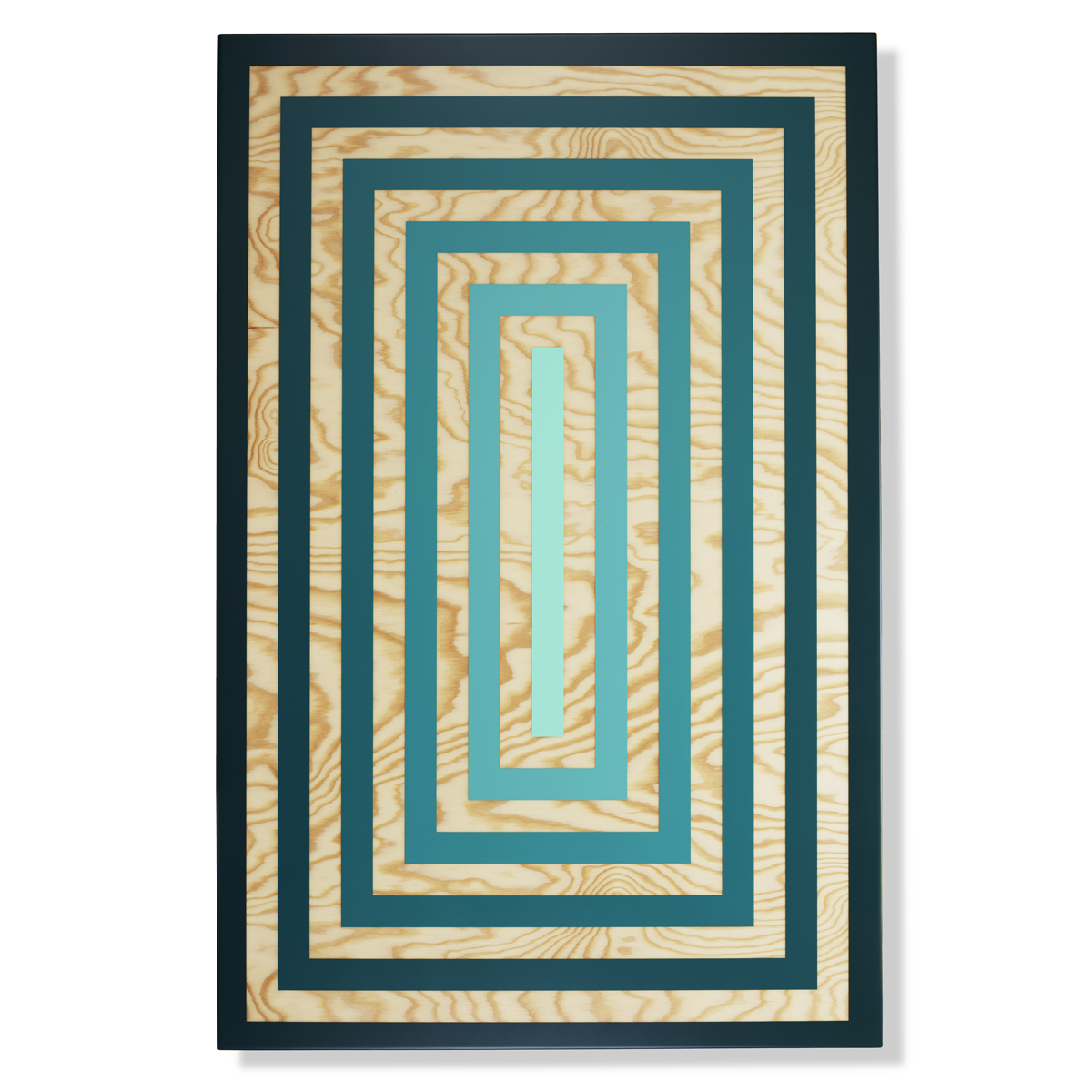
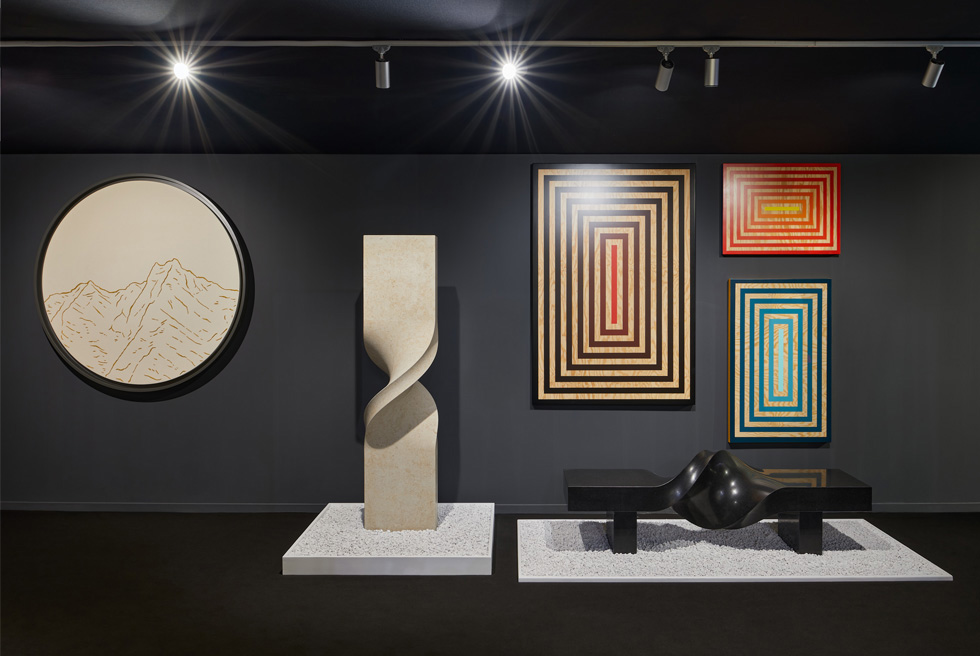
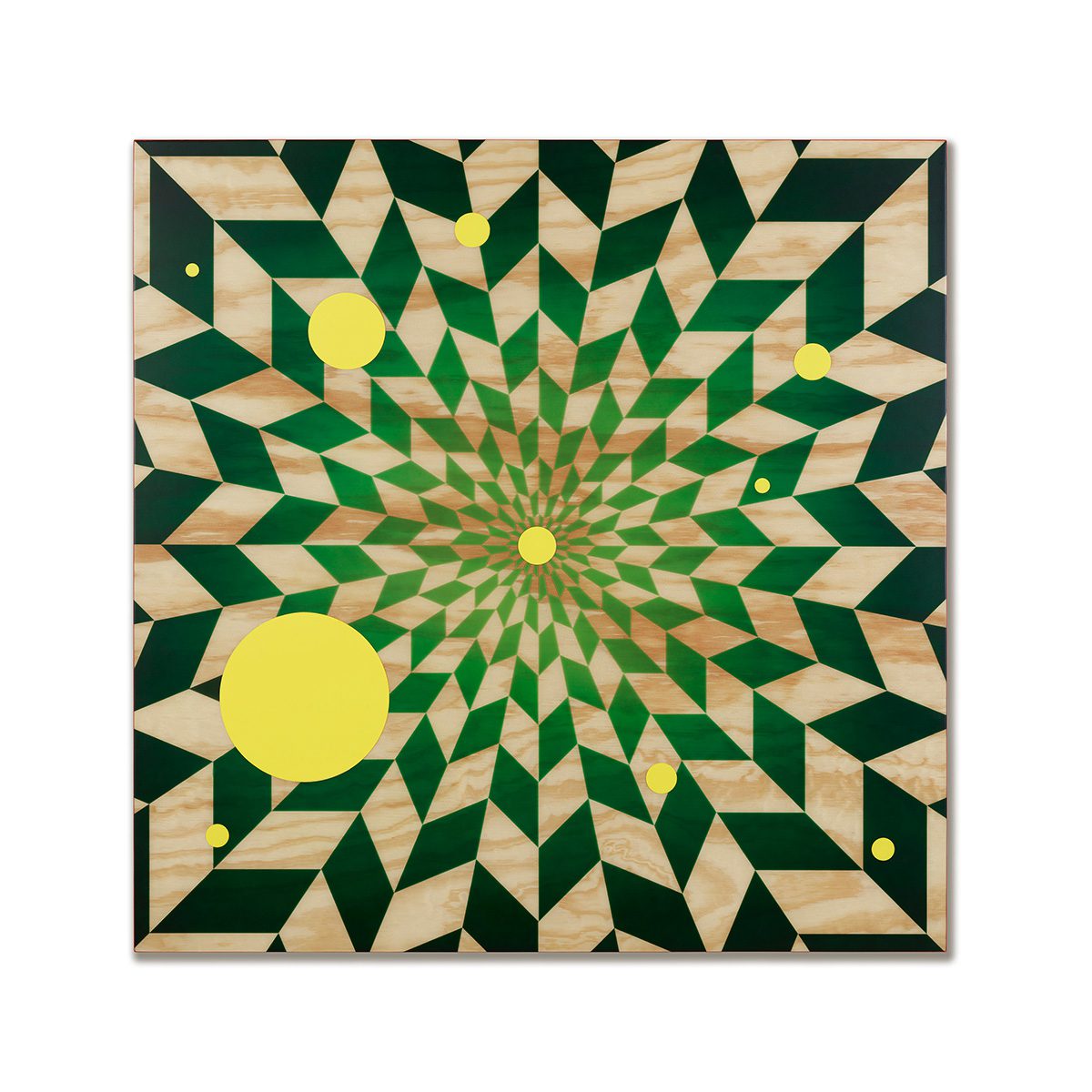
With the Dual Inheritance Theory series, Philippe Cramer develops a sculptural and pictorial investigation into the coexistence — at times harmonious, at times conflicted — between structures generated by nature and those constructed by human culture. Crafted from lacquered maritime pine, these works bring together two opposing visual systems: on one side, the organic grain of the wood, unpredictable and alive; on the other, rigorous geometric compositions inspired by the visual language of Op Art and kinetic abstraction of the 1960s and 1970s.
The title Dual Inheritance Theory borrows from an anthropological and evolutionary concept suggesting that human beings inherit simultaneously through biology and culture. In Philippe Cramer’s work, this idea becomes both a visual and material principle. The works stage a tension between two fundamental inheritances: nature, embodied by the slow and irregular growth of wood, and human culture, expressed through geometric systems that seek order, control, and rational structure.
This duality runs throughout the history of modern art. From the early twentieth century onward, geometric abstraction emerged from a desire to create a universal visual language grounded in harmony, repetition, and mathematical clarity. Artists such as Piet Mondrian, Josef Albers, and the Constructivists sought to detach form from the contingencies of nature in pursuit of an idealized and intellectual order. Later, during the 1960s and 1970s, Op Art expanded this ambition into a perceptual and immersive experience.
The dialogue with Victor Vasarely is particularly significant here. Much like Vasarely’s optical compositions, Philippe Cramer’s geometric patterns generate visual tensions, vibrations, and shifting spatial perceptions that destabilize the viewer’s gaze. Surfaces appear to expand, pulse, or recede through the repetition of lines and chromatic structures. Yet where historical Op Art often pursued perfectly controlled, almost industrial surfaces, Philippe Cramer introduces an element of resistance: the irreducible presence of the living material itself.
Beneath the lacquered geometry, the maritime pine always remains visible. Its veins, knots, irregularities, and organic accidents persist as an autonomous form of drawing that human intervention can never fully erase. The wood therefore becomes far more than a support; it operates as a living memory, a natural structure onto which human systems of order are projected.
This tension forms the conceptual core of the series. The geometric motifs attempt to impose logic, symmetry, and rational control, while the material quietly resists. The grain of the pine continuously reintroduces unpredictability, irregularity, temporality, and a form of organic intelligence. The works become the site of a dialogue between two forms of drawing: that of nature and that of humankind.
The first is slow and involuntary, shaped by climate, growth, and time. The second is constructed, calculated, cultural, and almost mathematical. Philippe Cramer does not seek to erase one in favor of the other; instead, he stages their coexistence.
This relationship between geometric structure and organic materiality also echoes broader tensions within the history of modernity itself. Twentieth-century abstraction often carried the ambition of establishing universal systems capable of transcending the chaos of the natural world. In Dual Inheritance Theory, this modernist aspiration encounters a distinctly contemporary awareness: the understanding that nature can no longer be considered a passive material entirely subject to human control.
The works may therefore be read as metaphors for our present relationship with the environment. Human systems — architectural, technological, political, or cultural — continuously attempt to organize the world according to rational models, while natural forces persist in following their own autonomous and often uncontrollable logic.
This gives the series a deeply contemporary resonance. Philippe Cramer reactivates the visual vocabulary of modernism and Op Art while redirecting it toward current questions surrounding ecology, materiality, coexistence between culture and nature, and the limits of human control.
The choice of maritime pine is especially significant in this context. Unlike the neutral industrial surfaces traditionally associated with geometric abstraction, this wood possesses a strong expressive presence. Its grain functions like a natural cartography or an internal topography. Certain organic lines appear to harmonize with the painted geometries, while others interrupt or contradict them.
This interaction generates a unique visual vibration. The eye constantly oscillates between two perceptual systems: geometric stability and organic movement. The viewer is never able to fully settle on either one. The surface becomes a field of perceptual negotiation where human order and natural growth coexist without ever completely merging.
This approach also connects Philippe Cramer to artists who explored the relationship between system and organicity. Bridget Riley’s work resonates through the perceptual dynamism of the surfaces, while Giuseppe Penone and artists associated with Arte Povera similarly investigated the memory embedded within natural materials. More recently, many contemporary artists have reintroduced unstable or living materials into abstraction in order to question the legacies of modernism.
Yet Philippe Cramer’s work maintains a distinct position. Rather than rejecting geometric modernism, Dual Inheritance Theory proposes a form of coexistence. The geometric structures do not erase the wood; they enter into dialogue with it. The works do not stage absolute domination, but rather an ongoing negotiation between control and surrender, culture and organic growth, calculation and chance.
The lacquer itself plays a crucial role within this tension. Its smooth, refined and synthetic surface contrasts with the tactile depth and living texture of the wood beneath. This opposition between polished finish and organic material further intensifies the central duality of the series. Beneath the geometric order, the wood always retains something untamed.
In Dual Inheritance Theory, Philippe Cramer transforms the surface into a philosophical space. Each work becomes a meditation on the human impulse to project systems of thought onto the natural world while remaining confronted by an organic reality that can never be fully mastered.
The works ultimately emerge as hybrid objects — simultaneously modernist and organic, rational and instinctive, controlled and alive — surfaces where the history of geometric abstraction encounters the slow and silent memory of living matter.
19.05.2026


