
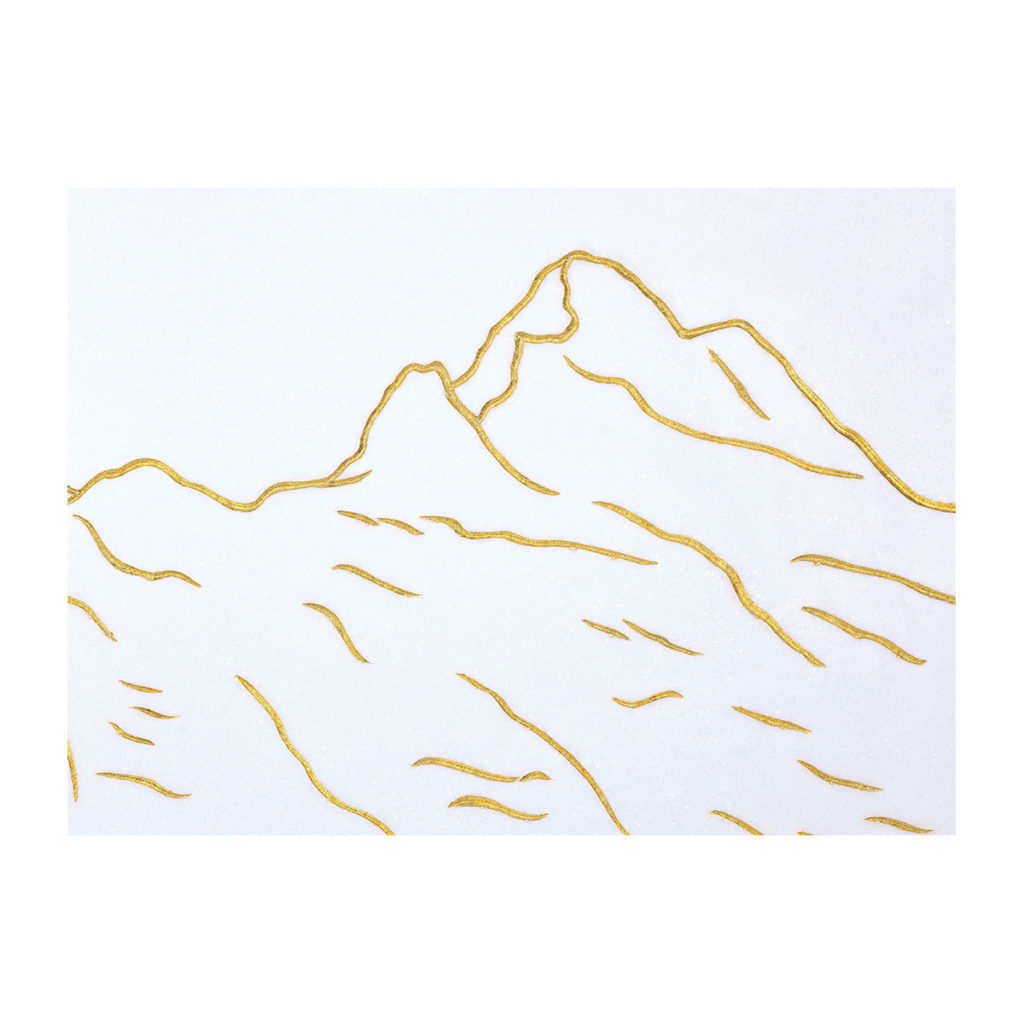
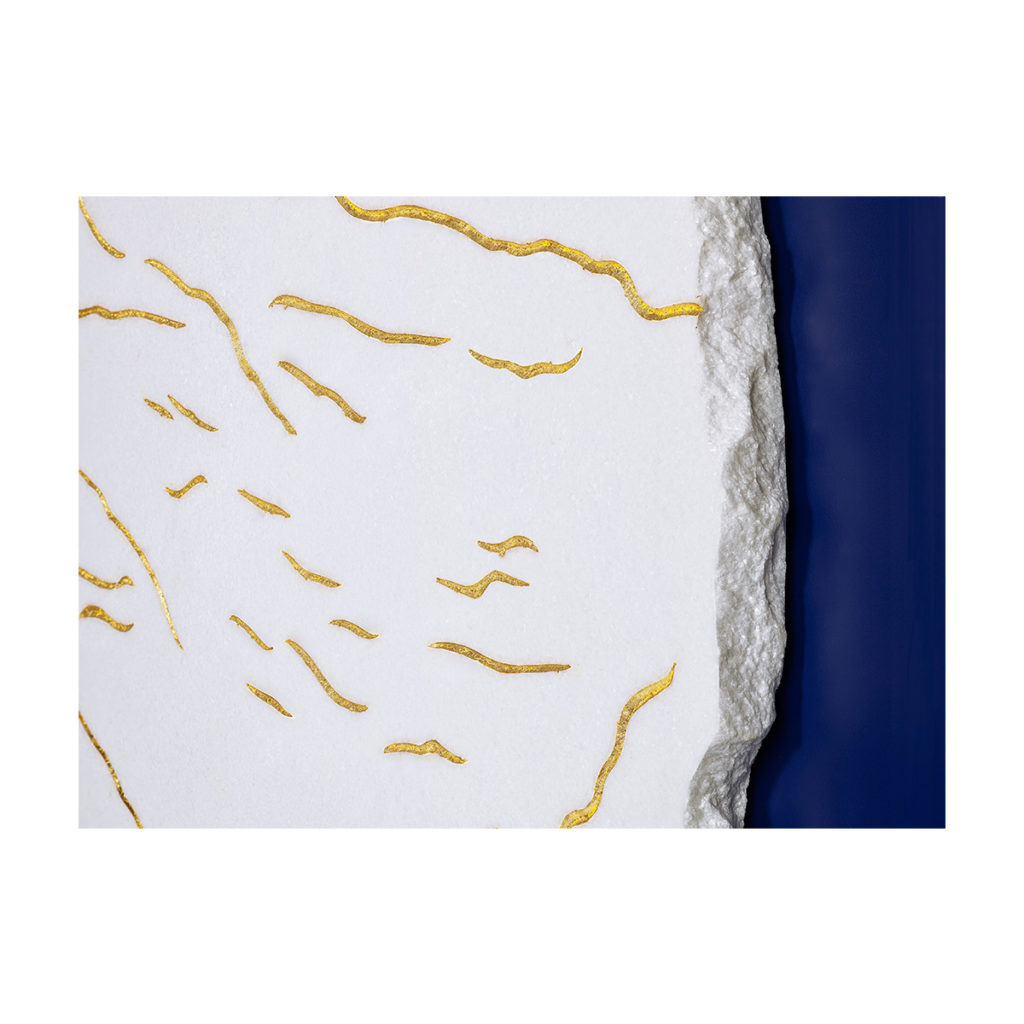
GOLDEN LANDSCAPES : GRINDELWALD GLACIER
2024
In his Golden Landscapes, Philippe Cramer extends the history of Swiss Alpine representation while shifting it into a distinctly contemporary territory, where landscape becomes at once a meditative surface, a precious object, and a silent presence.
Executed in gold thread embroidery on cotton canvas, his works belong to a distant lineage rooted in the Geneva school of mountain painting of the 19th century, initiated by Alexandre Calame and later transformed by Ferdinand Hodler. Yet where Calame sought to capture the dramatic force of the Alpine sublime — storms, glaciers, forests, and atmospheric effects — Philippe Cramer operates an inverse movement: he gradually strips the landscape of narrative, anecdote, and theatricality in order to focus on the very essence of the relief.
The fascination with mountains that emerged in European art from the 18th century onward is inseparable from the concept of the sublime theorized by Edmund Burke in 1757. This “delightful terror” describes a feeling that combines admiration, vertigo, and awe in the face of a nature whose grandeur exceeds human scale. Few landscapes embody this experience as intensely as the Alps. Long perceived as hostile and unsettling, the mountain gradually becomes a space of spiritual elevation, contemplation, and transcendence.
Thinkers of the Enlightenment played a crucial role in this transformation of perception. Jean-Jacques Rousseau viewed the mountain as a place of purity and authenticity, while Albrecht von Haller celebrated its beauty as early as 1732 in his poem Die Alpen. At the same time, the first travelers of the Grand Tour crossed Alpine passes, disseminating throughout Europe the image of a sublime and majestic Switzerland. The ascent of Mont Blanc by Horace Bénédict de Saussure in 1787, accompanied by the illustrations of Marc-Théodore Bourrit, marked a turning point where scientific exploration, Alpine adventure, and artistic representation became closely intertwined.
Romanticism soon fully embraced the mountain. In Wanderer above the Sea of Fog (1818), Caspar David Friedrich confronts the human figure with an infinite nature that becomes a reflection of the divine. In England, Turner’s travels across the continent and his encounter with the Alps transformed his painting through mist, vapor, and atmospheric phenomena. In Switzerland, Pierre-Louis De la Rive inaugurated a new vision of Mont Blanc, already treating the mountain as an autonomous, almost iconic figure.
It is within this context that the Geneva school of landscape painting emerged, led by Alexandre Calame and François Diday. Their grand compositions — sometimes described as true “theatrical machines” — imbued the Alps of Valais and the Bernese Oberland with dramatic and even patriotic intensity. Storms, glaciers, precipices, and twilight light constructed a powerful Alpine mythology that radiated throughout Europe. Their studios attracted artists from across the continent, including Gabriel Loppé, himself an accomplished mountaineer, whose views of the Mer de Glace contributed to this aesthetic conquest of the peaks.
With Ferdinand Hodler, however, a decisive shift occurs. In works such as The Jungfrau in the Mist (1908), the classical structure of landscape inherited from the Renaissance dissolves: the foreground disappears, and the mountain seems to float above a sea of clouds in an almost abstract space. Hodler compresses the composition until the summit becomes an autonomous subject. The mountain is no longer a setting; it becomes a presence.
Philippe Cramer appears to continue this evolution while taking it one step further. The mountain is no longer merely monumental — it becomes an icon.
The Golden Landscapes series offers a dreamlike vision of the Swiss Alps — an ode to the beauty of these millennial natural monuments that have shaped the country’s imagination for centuries. Jungfrau, Eiger, Weisshorn, and Monte Rosa emerge as timeless figures within the Swiss collective memory, long associated with narratives of exploration, alpinism, and Romantic fascination with the sublime.
This mythological dimension reconnects directly with the spirit of Romantic painters and the Geneva school, captivated by the grandeur and near-metaphysical character of the Alps. Yet Philippe Cramer translates this legacy into a radically distilled and contemporary visual language.
This transformation begins with the choice of medium. Gold thread carries a dense symbolic history. Before becoming decorative, it belonged to the realm of the sacred: liturgical textiles, priestly garments, medieval reliquaries, Byzantine embroidery, altar cloths, and illuminated manuscripts. In both Western and Eastern traditions, gold does not simply represent light; it acts as a vehicle of transfiguration. In Byzantine icons, the mosaics of Ravenna, or the gilded backgrounds of Duccio and Cimabue, gold removes figures from earthly time, placing them within a suspended, timeless, spiritual space.
In Philippe Cramer’s works, this material memory remains palpable. Gold thread does not merely describe Swiss topography; it sacralizes it. The mountains cease to be identifiable landscapes and become contemplative, almost votive presences. As in religious icons, gold does not reproduce natural light — it transforms the subject into an apparition.
This dimension is further reinforced by the use of traditional gold embroidery techniques historically reserved for royalty and high-ranking clergy. Each work is entirely hand-embroidered using 12-carat gold thread by France’s sole Maître d’Art specialized in gold embroidery, whose practice includes the making of academic regalia and liturgical vestments. This continuity of craftsmanship imbues each piece with a strong historical and symbolic density. The act of embroidery itself becomes a form of ritual.
Unlike drawing or painting, which can allow for immediacy, embroidery imposes a slow, repetitive, and accumulative temporality. Each topographic line is reconstructed thread by thread in a process akin to meditation. This patience recalls monastic craftsmanship, manuscript illumination, and sacred textile traditions. Time is not merely represented in the work — it is physically embedded within it.
The threads follow the contours of the terrain like contour lines. Mountains become visual scores, embroidered geologies, and sensitive cartographies where relief is translated into rhythm and luminous vibration. Reduced to their essence, these topographies approach abstraction. The monochrome gold compositions on white ground produce forms that seem almost immaterial, suspended between territorial representation and graphic inscription.
This formal reduction occasionally aligns Philippe Cramer’s work with certain contemporary minimalist and meditative practices. One might think of Agnes Martin, whose silent, repetitive structures evoke contemplation, or of Gerhard Richter’s misty landscapes of Davos, which extend the ethereal legacy of Caspar David Friedrich. In the field of textile art, Sheila Hicks has likewise elevated fiber beyond decoration into an autonomous sculptural and conceptual language.
The complete absence of human presence further reinforces this sense of timelessness. Unlike much of traditional Alpine painting — populated by travelers, mountaineers, chalets, and paths — Philippe Cramer’s mountains exist in absolute solitude. They are neither conquered nor inhabited. They appear both prior and subsequent to human existence. This absence generates a form of silent monumentality that resonates as much with Romantic sublimity as with a certain mystical tradition.
The circular format — the tondo — plays a fundamental role in this visual experience. Historically associated with devotional imagery of the Italian Renaissance, the tondo concentrates the field of vision and extracts the subject from narrative flow. In Philippe Cramer’s work, it functions almost as an optical device. Evoking the experience of looking through binoculars, it draws the viewer into an immersive act of contemplation. The mountain becomes at once medallion, reliquary, and apparition.
The circle eliminates the traditional horizon of Western landscape painting, transforming the image into a self-contained meditative object. This silent frontality recalls both Hodler’s late works and much older traditions of sacred imagery. One thinks of Orthodox icons, where figures isolated against gold grounds no longer belong to naturalistic representation but to presence itself. Philippe Cramer’s mountains seem to operate in a similar way: they are not simply observed — they return the gaze.
There is also a subtle resonance with Geneva’s own cultural history. Marked by Protestantism and a longstanding suspicion toward sacred imagery, the city developed an aesthetic of restraint and sobriety. By reintroducing gold, preciousness, and a form of icon-like contemplation into the Swiss landscape, Philippe Cramer reactivates a sacred dimension of vision without reverting to traditional religious imagery. As André Gide wrote, “the admiration of mountains is an invention of Protestantism.” This statement illuminates how the Alps became, in modern Europe, a site of both inner revelation and aesthetic inquiry.
In the Golden Landscapes, the Swiss mountain definitively ceases to be a landscape. It becomes relic, presence, and memory — a sacred geology.
19.05.2026


