
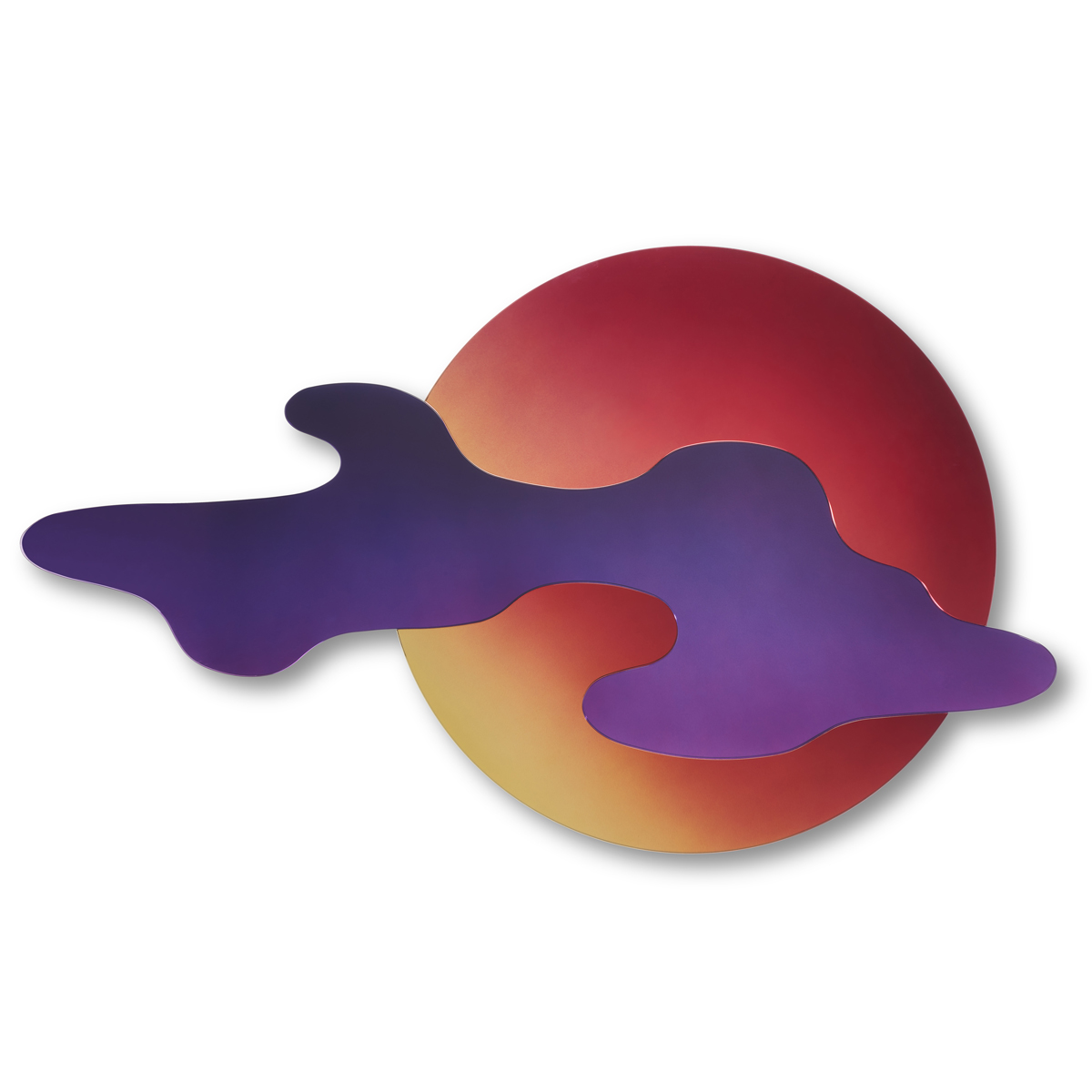
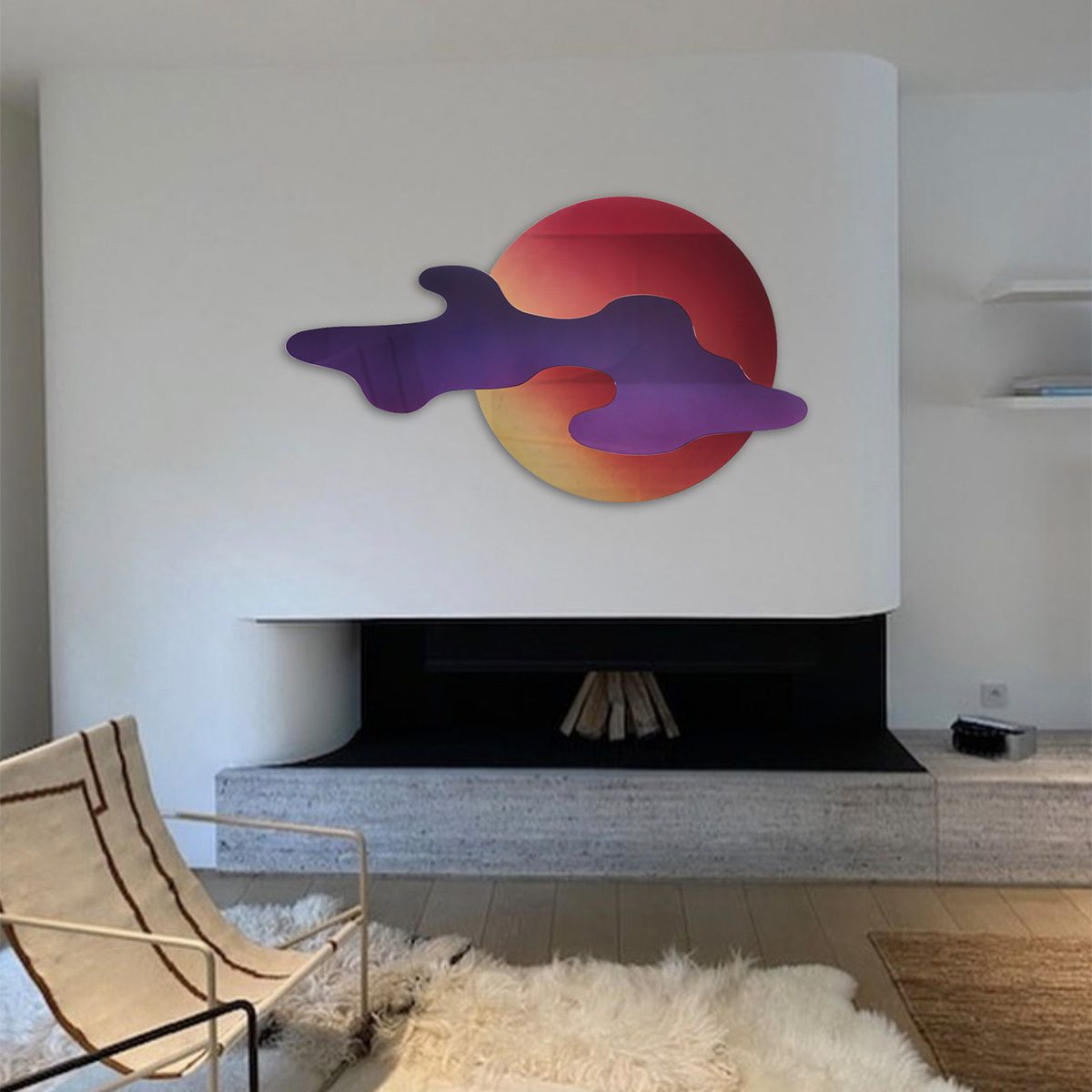

ONAR N° 6
With the ONAR series, Philippe Cramer explores one of the most enduring subjects in the history of art: the unstable boundary between reality and illusion. Neither painting, nor sculpture, nor mirror in the conventional sense, these works occupy a liminal territory where perception becomes fluid and certainty gives way to wonder.
The title itself provides an important clue, as Onar, the Ancient Greek word for “dream,” situates the series within a realm of shifting appearances and altered realities. The works function as portals rather than images, inviting viewers into a space where the familiar world is subtly transformed. Reflection becomes mirage; reality becomes projection.
The origin of the series lies in a personal experience. During a journey through the desert landscapes between Los Angeles and Las Vegas, Philippe Cramer became fascinated by the phenomenon of mirages produced by the reflection of sunlight on heated asphalt. These fleeting optical events create a temporary duplication of reality, blurring distinctions between what is present and what is imagined. This moment of perceptual uncertainty became the conceptual foundation of Onar. The works explore that fragile threshold where vision can no longer be entirely trusted and where reality begins to dissolve into possibility.
Historically, mirrors have occupied a unique position within the visual arts. They have served as symbols of truth, vanity, self-knowledge, illusion, and transcendence. From Jan van Eyck’s Arnolfini Portrait to the enigmatic reflections of Velázquez’s Las Meninas, the mirror has long been a device through which artists question the nature of representation itself.
In the twentieth and twenty-first centuries, mirrors became increasingly autonomous artistic materials. Michelangelo Pistoletto transformed reflective surfaces into participatory spaces where the viewer becomes inseparable from the work. Anish Kapoor has used mirrored forms to destabilize spatial perception and create experiences that oscillate between the physical and the immaterial. More recently, artists such as Jeppe Hein and Olafur Eliasson have explored reflection as a tool for altering our relationship to space, movement, and consciousness.
Onar enters into dialogue with this lineage while occupying a distinctly personal position.
Unlike traditional mirrors, these works do not simply reflect the world back to the viewer. Through a complex process involving laminated glass and hand-painted color gradients embedded within the structure of the mirror itself, Philippe Cramer transforms reflection into a mutable phenomenon. The reflected image becomes tinted, fragmented, softened, or intensified. Reality remains visible, yet it is subtly displaced. The mirror ceases to function as a neutral instrument and becomes an active agent of transformation.
This technical process is central to the work. Borrowed from industrial laminated-glass manufacturing, the technique normally serves a purely functional purpose: safety. Philippe Cramer appropriates and redirects this industrial process toward poetic ends. A painted acetate layer is inserted between sheets of glass, allowing color to inhabit the reflective surface itself. The result is neither painting nor mirror, but a hybrid object in which image, color, transparency, and reflection coexist.
This dialogue between craftsmanship, industry, and illusion echoes a broader concern that runs throughout Philippe Cramer’s practice. Much like his embroidered mountain landscapes, his sculptural bronzes, or his interventions on stone and wood, Onar emerges from the encounter between material knowledge and symbolic imagination. The work remains rooted in technical mastery while seeking to evoke experiences that resist rational explanation.
The cloud-like silhouettes that define many of the Onar works introduce another important layer of meaning. Throughout human history, clouds have occupied a privileged place within the imaginary. They are among the most unstable and mutable forms found in nature, continuously shifting between appearance and disappearance. For Leonardo da Vinci, cloud formations offered a source of creative inspiration capable of revealing hidden images and narratives. For the Romantics, they became manifestations of the sublime and the infinite.
In Philippe Cramer’s work, these forms function less as representations of clouds than as thresholds between worlds. Their contours remain deliberately ambiguous, oscillating between celestial body, atmospheric phenomenon, portal, and apparition.
This celestial dimension resonates with one of humanity’s oldest symbolic systems, the veneration of the sky.
Long before the development of organized religions, the sun, the moon, and the planets were understood as sacred forces governing life on Earth. Ancient Egyptian, Mesopotamian, Greek, and Mesoamerican cosmologies all placed celestial bodies at the center of their understanding of existence. The sun in particular was often conceived as both a physical and spiritual force, simultaneously illuminating the world and structuring the rhythms of life.
Within Onar, the luminous gradients and radiant chromatic transitions often evoke solar phenomena. Certain works appear as fragments of eclipses, celestial disks, or atmospheric halos suspended between presence and disappearance. The reflected light recalls not only the mechanics of vision but also the symbolic role that light has played throughout human history as a metaphor for knowledge, revelation, and transcendence.
In this regard, the series establishes a subtle dialogue with artists who have used light as a primary material. Dan Flavin transformed industrial light into sculptural form. James Turrell dissolved architecture into pure perception. Olafur Eliasson constructed environments that heighten our awareness of atmospheric phenomena. Yet unlike these artists, Philippe Cramer retains the reflective object as a central protagonist. Light remains inseparable from the mirror, and perception remains anchored in the viewer’s own image.
The spectator occupies a unique position within the work.
Unlike traditional paintings or sculptures that can be observed from a distance, Onar cannot exist fully without the presence of the viewer. Each movement alters the reflected image. Each change in ambient light generates new visual conditions. The work continuously reconfigures itself according to its surroundings. It is never entirely fixed.
Yet Philippe Cramer does not simply seek participation. Rather, he invites a form of contemplation rooted in uncertainty. The viewer encounters not their reflection but a transformed version of it. The work creates a space where reality is neither denied nor affirmed, but suspended.
This notion of suspension lies at the heart of the series.
The mirrors become contemporary instruments of reverie. They evoke ancient practices of divination associated with reflective surfaces; while remaining firmly grounded in the language of contemporary art. Throughout history, mirrors have often been associated with prophecy, magic, and access to invisible worlds. In ancient catoptromancy, reflective surfaces were used as tools of revelation and prediction. Philippe Cramer reactivates this symbolic heritage without embracing mysticism directly. Instead, he explores the enduring human desire to glimpse realities beyond the immediately visible.
In a contemporary culture increasingly mediated by screens, images, and digital reflections of the self, Onar offers a striking alternative. These works do not produce information; they produce ambiguity. They do not clarify reality; they complicate it. They remind us that perception is never neutral, that every image is filtered, and that wonder often begins where certainty ends.
Through Onar, Philippe Cramer transforms the mirror from an instrument of recognition into a vehicle for imagination. Between dream and reality, reflection and apparition, technology and poetry, the series proposes a contemporary meditation on one of the oldest questions in art: how do we distinguish the world we see from the worlds we imagine?


