
CELESTIAL BODY: WOLF 1069
2025
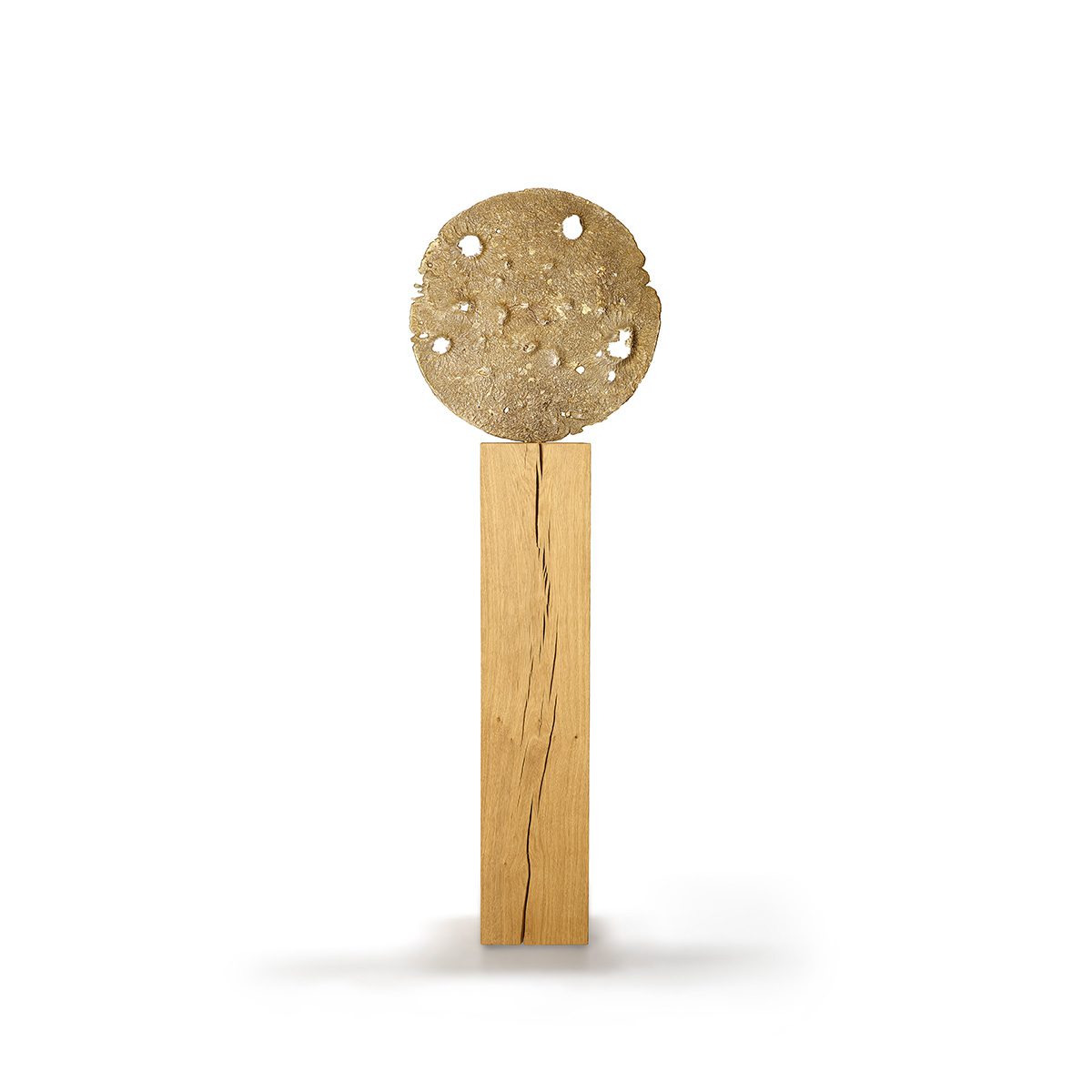
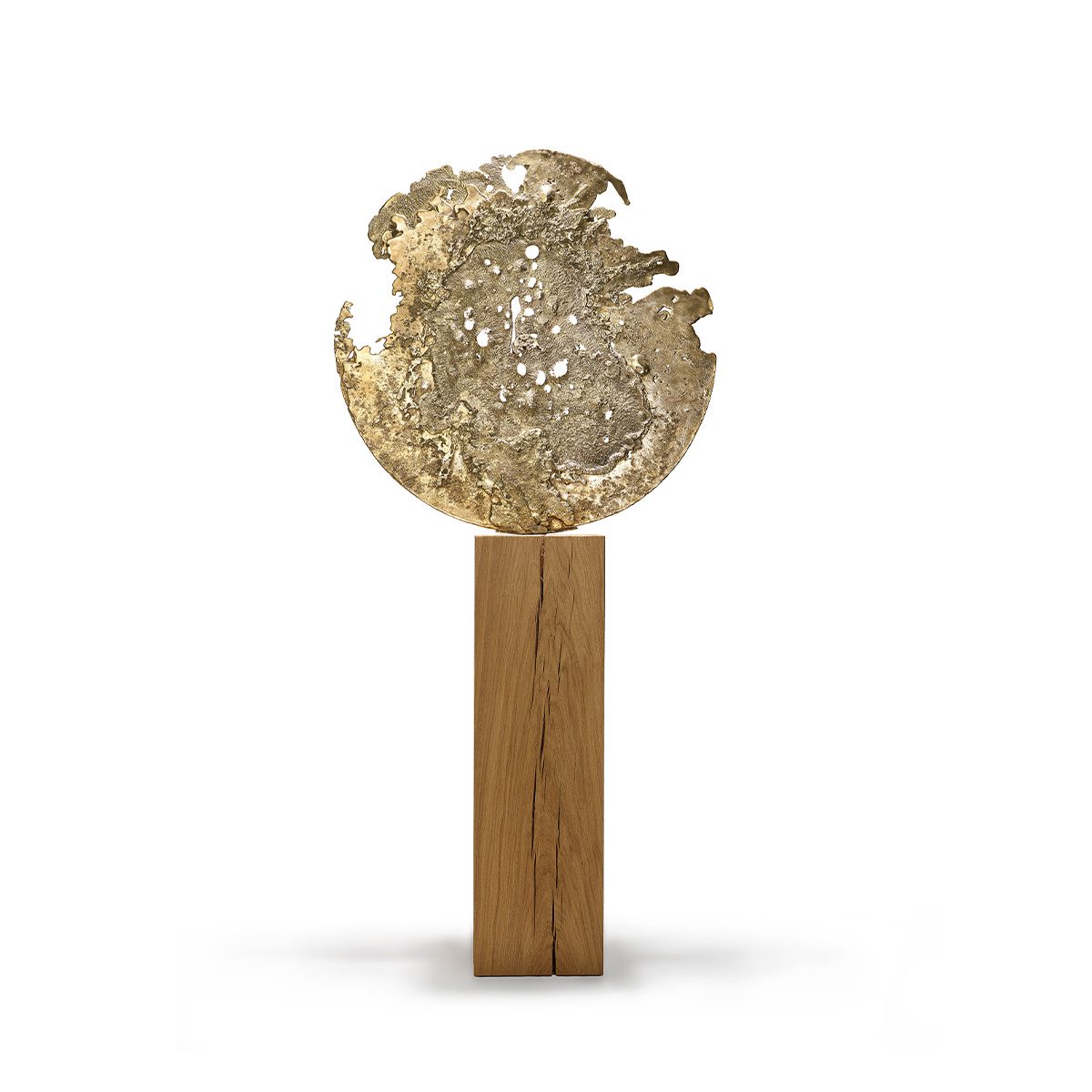
With the Celestial Bodies series, Philippe Cramer extends a sculptural inquiry into presence, memory, and the sacred dimension of form. Made in poured bronze raw oak, these works take the shape of vertical, totemic figures — silent, monumental presences situated at the intersection of archaic sculpture, modern abstraction, and ritual object.
Celestial Bodies situates itself within a long history of sculpture in which the object transcends its material condition to become symbolic presence. These works seem to belong to an indeterminate temporality — at once ancient and contemporary, primitive and futuristic, terrestrial and cosmic. Their stable, almost ceremonial verticality imbues them with an immediate meditative force.
The title itself — Celestial Bodies — opens a dual imaginary: that of astronomical entities, planetary trajectories, and cosmic systems, but also that of the sculptural body as an autonomous presence. Each piece appears as a gravitational form, dense and silent, structured around a central axis that recalls ancient stelae as much as votive artefacts or archaic anthropomorphic figures.
This relationship between abstraction and spirituality runs throughout the history of modern sculpture. The dialogue with Constantin Brancusi is significant here. As in Endless Column, The Kiss, or Bird in Space, form is reduced to its essence to approach a universal, almost metaphysical dimension. Brancusi sought not to represent the appearance of the world, but to reveal its inner energy. Philippe Cramer pursues a similar trajectory, developing condensed forms that escape visual narrative to attain a state of pure presence.
At the same time, the work engages with far more ancient traditions. The Celestial Bodies evoke Cycladic sculpture, primitive idols, megalithic standing stones, as well as ritual figures from African and Oceanic cultures that profoundly influenced the avant-gardes of the twentieth century. Like these sacred objects, Cramer’s sculptures carry a symbolic charge that exceeds their aesthetic status. They function as presences — contemplative, almost tutelary forms.
This sacred dimension is reinforced through the choice of materials. Bronze, since Antiquity, has carried a powerful historical and symbolic weight. A material of permanence and monumentality, it traverses civilizations as a bearer of memory and authority. Raw oak, by contrast, introduces an organic, terrestrial, and almost archaic dimension. Its grain, irregularities, and living texture create a tension with the dense, mineral surface of the bronze.
The bronze disc appears to hover above its oak base like an apparition, or a condensation of matter. This duality recalls certain works by Isamu Noguchi, in which sculpture becomes a dialogue between nature, time, and human intervention.
In Philippe Cramer’s practice, bronze itself becomes a field of research. In contrast to industrial or standardized casting processes, each alloy is developed by hand within the studio. The bronze used in Celestial Bodies is entirely self-produced: Philippe Cramer and his collaborators create their own metallic compositions prior to casting.
This aspect is essential, as bronze does not exist in a natural state. It is a fully man-made material, an alloy born from the transformation of multiple metals — primarily copper, brass, and tin. By adjusting the proportions of each component, the material develops distinct tonalities: warmer and reddish when copper dominates, more golden when brass is present in greater quantities, and cooler, almost silvery when tin becomes more prominent.
Each sculpture thus possesses its own chromatic vibration and material identity. Subtle surface variations generate slightly different presences, as though each work contained its own internal temperature. This mastery of alloy aligns Cramer’s practice with historical traditions of artistic foundry, when the sculptor maintained a direct, almost esoteric relationship with the transformation of matter.
This relationship to material resonates with a much older lineage — that of alchemy. For centuries, alchemists sought to understand the hidden forces within metals, their symbolic correspondences, and their transformative potential. Fire, fusion, and alloying were as much spiritual processes as material operations. In Celestial Bodies, Philippe Cramer discreetly reactivates this alchemical memory. The transformation of copper, brass, and tin into a unified substance evokes a form of transmutation in which distinct elements merge to give rise to a new presence.
This dimension lends the sculptures a magical quality. Each bronze disc appears as the result of a ritual governed by fire, time, and gravity. Variations in color become visible traces of this inner metamorphosis. Reddish, golden, or silvery surfaces echo ancient cosmologies in which metals were associated with planets, deities, and celestial forces. Copper, linked to Venus in hermetic traditions, tin associated with Jupiter, and the solar resonance of gold — subtly echoed in the reflective qualities of bronze — extend within these works an ancient imaginary in which matter, cosmos, and spirituality were deeply intertwined.
The title Celestial Bodies thus acquires an expanded resonance. The sculptures no longer refer solely to celestial objects as astral forms; they seem themselves to emerge from a cosmic process — like mineral fragments from a forgotten mythology, or relics of a civilization both archaic and yet to come.
As in the Golden Landscapes, Philippe Cramer places fundamental importance on artisanal gesture. Each work is entirely handcrafted in Switzerland in collaboration with highly skilled artisans mastering traditional techniques of bronze casting and woodworking. This collaborative dimension is essential, anchoring the sculptures within a historical continuity in which hand, time, and material remain central to the act of creation.
In a contemporary context largely defined by dematerialization, digital technologies, and industrial production, this commitment to craftsmanship acquires particular resonance. Philippe Cramer asserts a slow, physical relationship to matter. The traces of metal pouring, the textures of wood, and the subtle irregularities of the surfaces become visible markers of time embedded within the object.
This valorization of process is not nostalgic. Rather, it participates in a distinctly contemporary reflection on materiality, presence, and the renewed need for forms capable of carrying symbolic density. In an era saturated with images and immaterial flows, Celestial Bodies reintroduce a physical and contemplative experience of sculpture.
Their silence is one of their most striking qualities. These works avoid spectacle and resist explicit narrative. They impose a slowed temporality. Their monumentality is never demonstrative; it resides in their stability, their equilibrium, and their ability to generate a field of contemplation around them.
This restraint aligns Philippe Cramer’s work with modern sculptors such as Isamu Noguchi, Barbara Hepworth, or Eduardo Chillida, for whom sculpture was not merely form but a relationship between material, void, light, and space. In Cramer’s work as well, the pieces seem to quietly organize the space around them. They possess an architectural quality, functioning as axes or points of anchorage within a given environment.
At the same time, the Celestial Bodies never seek emotional neutrality. Their abstraction remains inhabited. The forms retain an anthropomorphic resonance, oscillating between object, figure, and symbol.
This ambiguity constitutes one of the central strengths of the work. The sculptures seem to belong simultaneously to an archaic world, to modern sculptural language, and to a form of contemporary spirituality stripped of explicit religious iconography.
In Celestial Bodies, Philippe Cramer thus constructs a singular sculptural language in which bronze and wood become the vehicles for a meditation on time, memory, and permanence — essential forms that appear as relics of the future as much as vestiges of an immemorial past.
19.05.2026


